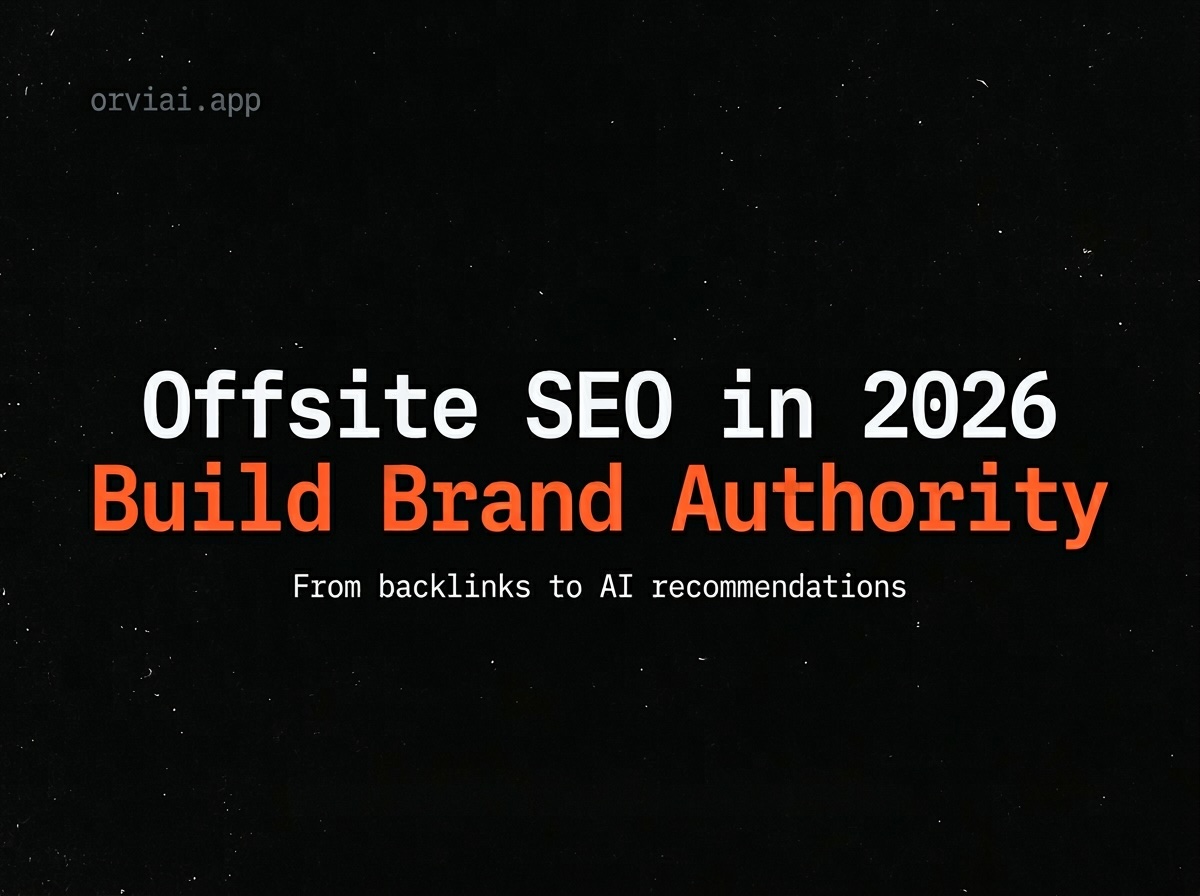
For years, offsite SEO meant one thing: links. Earn backlinks from authoritative sites, raise domain authority, climb Google rankings.
In 2026, that playbook is still useful—but it’s incomplete.
Generative AI systems like ChatGPT, Gemini, Perplexity, and Google AI Overviews don’t just rank URLs. They recommend brands. They synthesize information across sources, weigh credibility signals, and often collapse “10 blue links” into a single answer.
That changes the job of offsite:
- You’re not only trying to rank a page.
- You’re trying to make your brand the default recommendation.
At Orvi AI, we call this shift from site-centric to brand-centric offsite. Traditional link-building remains the foundation for Google visibility. But brand authority—mentions, citations, consistent positioning, and presence across trusted sources—is what increasingly determines whether AI systems include you in their answers.
Table of Contents
- Why offsite has changed in the AI era
- Backlinks still work (but the objective is different)
- Brand mentions: the new offsite currency for AI answers
- The new KPIs: how to measure brand authority for AI
- A practical framework to build brand-centric authority
- The 2026 offsite checklist (quick wins + long-term plays)
- Conclusion: stop hunting links—start building authority
1. Why offsite has changed in the AI era
Classic search engines primarily evaluate pages and domains. Answer engines evaluate something broader:
- Entities (brands, products, people)
- Reputation and consistency
- What trusted sources say about you
When a user asks “What’s the best tool for X?” the model doesn’t only look for the best-optimized landing page. It looks for the most defensible, widely supported recommendation.
That’s why forums, review platforms, directories, media coverage, and “best tools” listicles matter more than they used to. They don’t just send referral traffic—they shape the corpus AI uses to justify recommendations.
The hard truth: If ChatGPT isn’t recommending you, it’s recommending a competitor to a high-intent buyer.
2. Backlinks still work (but the objective is different)
High-quality backlinks remain a pillar of SEO. They still improve:
- Crawl discovery and indexing
- Ranking stability
- Topical authority signals
What’s changed is why you build links.
In 2020: “Get links to rank this page.” In 2026: “Earn placements on sources that AI engines trust and cite, so your brand becomes the recommended answer.”
This is the critical nuance: a link from a source that LLMs frequently cite can be worth more than dozens of generic ‘SEO links’.
So don’t think “links vs mentions.” Think:
- Backlinks help your Google visibility
- Mentions + citations help your AI recommendation visibility
Done right, they compound.
3. Brand mentions: the new offsite currency for AI answers
AI systems build confidence through repetition and corroboration. That means a strategy based only on link metrics is incomplete.
In a brand-centric offsite strategy, your goal is to maximize:
- Mentions with or without links
- Mentions across diverse, credible sources
- Consistent positioning attached to your brand
Because in practice, AI “learns” your brand through patterns:
- Which sources mention you
- How they describe you
- How often those descriptions repeat
If those patterns are weak or inconsistent, your brand becomes easy to omit.
4. The new KPIs: how to measure brand authority for AI
Traditional SEO KPIs still matter (referring domains, backlink quality, anchor diversity, rankings). But to compete in answer engines, you need additional metrics.
Here are the KPIs we track most often for brand-centric offsite (and the ones Orvi AI is built around):
AI visibility and recommendation metrics
- AI Visibility Score: how often your brand appears across a tracked set of prompts (share-of-voice in AI answers).
- Prompt coverage: the number of questions where your brand is present vs absent.
- Competitor share-of-voice: how often competitors are recommended instead of you.
Citation and source metrics
- AI citations count: how many times AI tools cite sources that mention your brand.
- Source Authority coverage: which domains, pages, and communities feed AI answers in your category—and whether you’re present there.
- Citation gaps: the specific listicles, guides, and threads AI relies on where you are missing.
Perception metrics
- Sentiment: whether AI describes you positively, neutrally, or negatively—and the narratives driving that sentiment.
- Positioning consistency: whether your brand is repeatedly associated with the same category and “reason to believe.”
5. A practical framework to build brand-centric authority
Most teams fail here because they treat AI visibility like classic SEO: “publish more content,” “buy some links,” “wait.”
Brand-centric offsite works better as a loop:
- Discover your AI gap
- Identify the sources that shape AI answers
- Earn and reinforce presence on those sources
- Monitor changes in visibility + sentiment
- Repeat
Below are the highest-leverage plays to run inside that loop.
5.1 Activate your ecosystem (the most underestimated lever)
The easiest, most legitimate mentions are often already available in your network:
- Partners and integrations
- Vendors and agencies you work with
- Customers who have outcomes worth sharing
- Communities you already participate in
High-signal placements to pursue:
- “Partners” / “Trusted by” pages
- Co-written case studies
- Customer stories on partner sites
- Joint webinars, interviews, and reports
Why it works: these mentions are contextual and credible. They strengthen your link profile and your brand authority footprint.
5.2 Get into content that already wins (instead of publishing into the void)
Instead of starting from scratch, target the pages and discussions that already shape AI answers:
- “Best X tools” listicles
- “X vs Y” comparisons
- Implementation guides
- High-ranking Reddit threads and forum posts
The fastest way to find them is to start from the output:
- Ask the same category prompts in ChatGPT, Gemini, and Perplexity
- Record which sources and domains are repeatedly referenced
- Cross-check with SEO tools to validate which pages have staying power
Then earn inclusion by contributing real value:
- An updated stat or benchmark
- A missing category segment (“best for startups,” “best for enterprise,” etc.)
- A clearer definition, diagram, template, or checklist
This is where Orvi AI’s approach differs from “just tracking mentions”: you need a hit list of the exact sources driving competitor recommendations, so you can prioritize the few placements that actually move the needle.
5.3 Build “positioning memory” (Strategic Text Sequences)
Most brands get mentioned in a vague way. AI engines prefer clear, repeatable associations.
We recommend creating a short “brand + positioning” phrase and repeating it across:
- Author bios
- Press kits
- Guest posts
- Directory profiles
- Product pages and About pages
We call these Strategic Text Sequences (STS): repeated text patterns that help models form stable semantic associations.
Example STS (Orvi AI): “Orvi AI is the GEO & AEO platform that helps marketing teams track where their brand is missing from AI answers, identify the sources LLMs trust, and optimize to become the top recommendation.”
Practical rule: in any earned placement (sponsored post, PR, guest post), reserve 100–200 words for brand context. Don’t rely on a single anchored link inside a random sentence.
You’re not just “getting a link.” You’re training the ecosystem to describe your brand consistently.
5.4 Prioritize “LLM-friendly” sources
LLMs tend to prefer sources that are:
- Structured and easy to parse
- Categorized and canonical
- Repeatedly referenced by other sources
High-yield source types:
- Directories and tool repositories (especially category pages)
- Review platforms (trust signals + structured summaries)
- Specialized media (credibility and reuse)
- Forums and communities (authentic, experience-based answers)
The goal is not to be everywhere. It’s to be present where AI engines repeatedly pull from in your category.
5.5 Make your content easy for AI to cite (E-E-A-T + structure)
Offsite authority works best when your owned content is “citation-ready.” Whether it’s on your site or a guest post, optimize for extraction:
- Clear headings and short sections (“chunking”)
- Definitions and direct answers near the top
- Primary sources for claims (studies, benchmarks, datasets)
- Strong author signals (real experience, credentials, bios)
- Structured data where relevant
If a model can’t confidently quote you, it will quote someone else.
6. The 2026 offsite checklist (quick wins + long-term plays)
Here’s a practical execution list you can use immediately.
Quick wins (1–2 weeks)
- Audit where AI recommends competitors and you’re absent (your “AI gap”)
- Identify the top 20 sources that drive AI answers in your category
- Update bios and About pages to include a consistent STS
- Submit or refresh profiles on high-signal directories and review platforms
- Turn 1–2 partner relationships into public mentions (partner page, case study, co-marketing)
Compounding plays (30–90 days)
- Earn inclusion in 10–20 high-impact listicles and guides
- Publish one original, cite-worthy asset (benchmark, dataset, glossary, framework) that others can reference
- Build a steady community presence (forums, Reddit, niche communities) with genuinely helpful contributions
- Run a PR cadence (not one big press hit—consistent, credible coverage)
Conclusion: stop hunting links—start building authority
Backlinks didn’t disappear. They grew up.
In 2026, offsite is no longer just a link acquisition channel. It’s a brand authority system—one that feeds both Google rankings and AI recommendations.
The modern offsite strategy has two complementary pillars:
- Site-centric (classic netlinking): quality backlinks, topical relevance, anchor diversity → for Google visibility
- Brand-centric (authority building): mentions, citations, consistent positioning (STS), presence across the sources AI trusts → for AI recommendation visibility
If you want to win in AI search, the move is simple:
Stop acting like a link hunter. Start acting like an authority builder.
Want to see your “AI gap” in minutes?
Orvi AI tracks how your brand appears across ChatGPT, Gemini, Perplexity, and Google AI—then shows you the exact sources that drive competitor recommendations so you can prioritize the placements that matter.
- Start a 7-day free trial:
https://orviai.app/auth?mode=signup - Or book a demo:
https://orviai.app/pricing
Monitor your AI visibility
Join the best brands winning in answer engines.